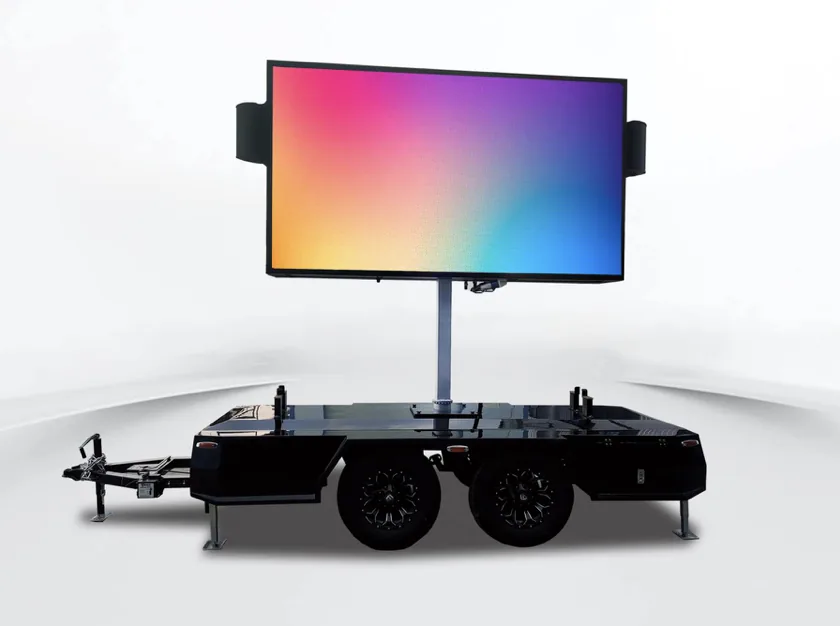
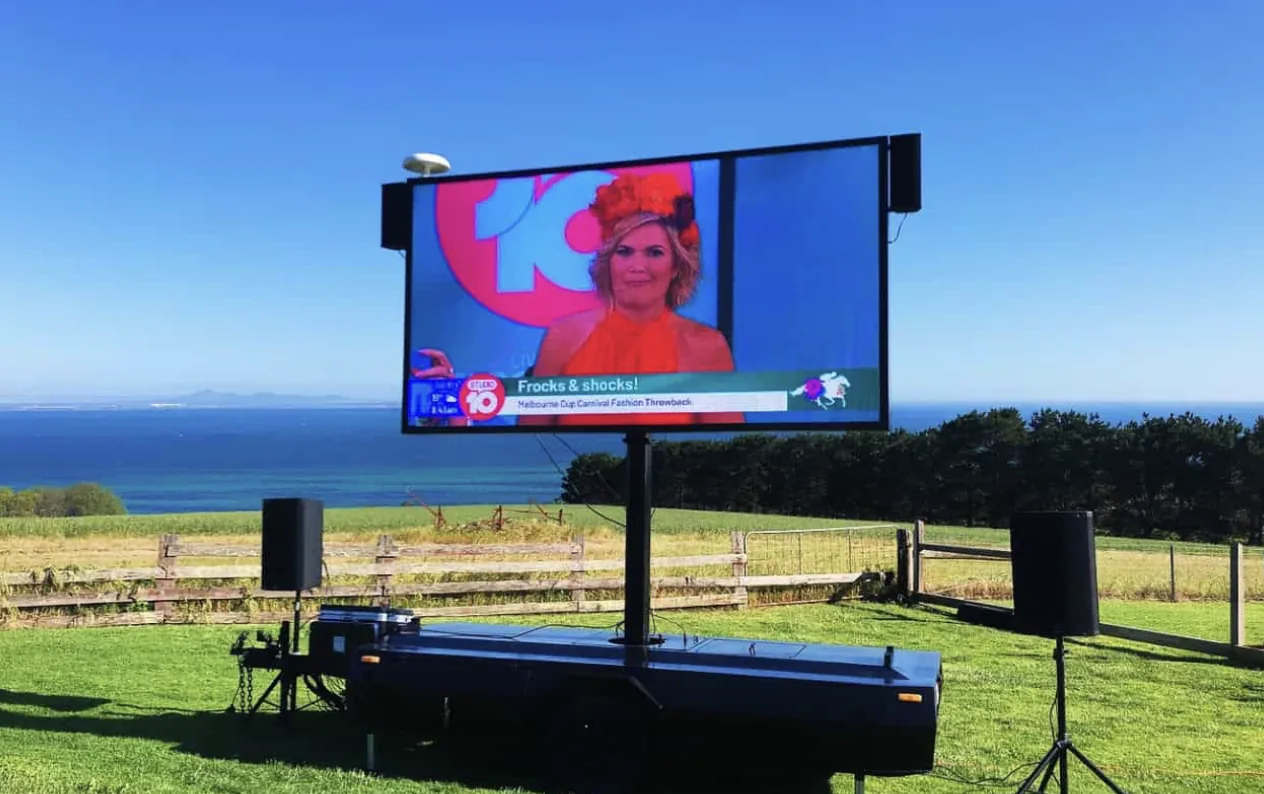
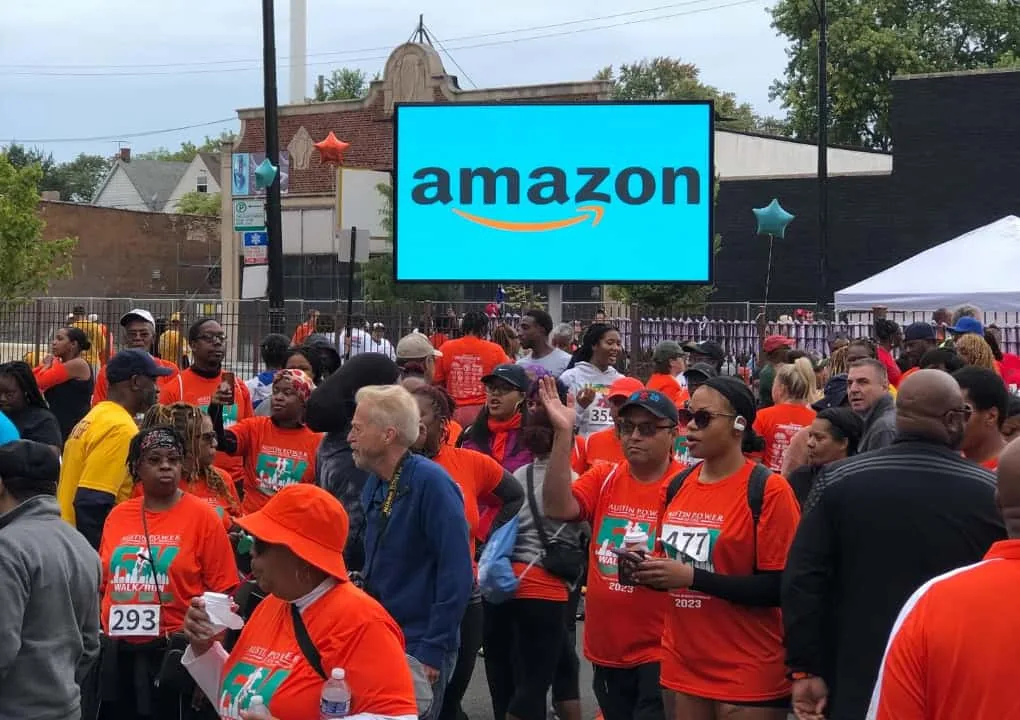
Screen size is the decision that is hardest to undo and easiest to get wrong in both directions. Too small and the back half of your crowd stops watching; too large and you have paid for square footage, tow weight and storage you never use. Here is how to size a mobile LED screen against the audience you actually have.
Start here
This chart is a starting point, not a formula. It assumes a reasonably concentrated outdoor audience watching video content. Use it to narrow to two models, then let viewing distance and site constraints pick the winner.
| Audience | Typical event | Screen area | Models that fit |
|---|---|---|---|
| Up to 200 people | Backyard, small church lawn, school classroom event | 48 - 75 sq ft | MB-5 Lite, MB-7 Lite |
| 200 - 500 people | Community movie night, small festival stage, corporate picnic | 75 - 108 sq ft | MB-7 Lite, MB-10 |
| 500 - 2,000 people | Town festival, high school stadium, tailgate lot, watch party | 108 - 170 sq ft | MB-10, MB-15, MB-15E |
| 2,000 - 5,000 people | Regional festival, concert side screen, large sporting event | 170 - 230 sq ft | MB-15, MB-22, MB-22E |
| 5,000 - 15,000 people | Headline festival stage, stadium lot, major public event | 230 - 300 sq ft | MB-28, MB-28E |
| 15,000+ people | Stadium-scale event, main-stage IMAG, arena overflow | 660 sq ft | MB-60E |
The number that matters more than headcount
Two events with 1,000 people can need completely different screens. What separates them is geometry: how far back the last viewer sits, and how close the first one stands.
As a practical planning rule, the comfortable viewing zone for video content runs to roughly 4 to 6 times the screen height, and content stops reading in useful detail somewhere around 10 times screen height. Run that both ways. A 10-foot-tall screen, like the MB-15 or MB-15E, comfortably serves viewers out to 40 to 60 feet and remains watchable to around 100. If your park lawn puts the back row 150 feet out, a 10-foot screen is not the answer no matter how many people are on it.
Pixel pitch is the distance between LEDs, and it determines how close someone can stand before the image breaks into dots. Spec pitch against your closest viewer, not your furthest. A crowd held 30 feet back by a stage barricade does not need a tight pitch and the budget is better spent on area. A screen with a camera pointed at it for broadcast IMAG, or one people walk right up to on a concourse, is the opposite case.
The reason these trailers replaced projection for daytime events is that full-brightness outdoor LED is legible in direct sun. Projection needs darkness and gets washed out at dusk, which is exactly when most outdoor events start. Any screen size in the MOBO line will outperform a projector at 6 p.m. in July; that is a property of the technology, not of the dimensions.
Before you pick a model, go stand at the back of the space where your biggest event happens and note the distance to where the screen would sit. That single measurement will narrow the choice faster than any chart, and it is the first question we will ask you on the phone.
The limits that overrule the chart
Buyers usually arrive wanting the biggest screen in budget and leave having bought the biggest screen that fits their life. These are the four reasons why.
Limit 01
Single-axle Lite models tow behind a half-ton. The tandem-axle MB-10 and MB-15 want a three-quarter-ton. Flatbed and enclosed models go up from there. If buying a bigger screen means also buying a bigger truck, count that in the comparison.
Limit 02
A 23-foot trailer with a folded mast will not fit a standard storage unit and often will not clear a carport. Covered storage extends the life of the screen and the hydraulics. Confirm what you can actually park before you size up.
Limit 03
Deployment needs a level pad, outrigger clearance, and room to rotate. City plazas, school courtyards and church lawns have tighter footprints than a stadium lot. The biggest screen you own is worthless at a venue it cannot set up in.
Limit 04
Small trailers run from a single 120V 30A twist-lock; mid-size models use 50A. If your venues cannot supply it, you need the onboard inverter or generator option, which is a cost and a weight consideration at every size.
Setup time scales with size too: about 10 minutes for the MB-5 family, about 15 for the MB-10 and MB-15, and roughly 20 for the big flatbed and enclosed models, all one person with no tools. Deployed, the outrigger legs stabilize the trailer in winds to 45 mph.
Sizing up the line
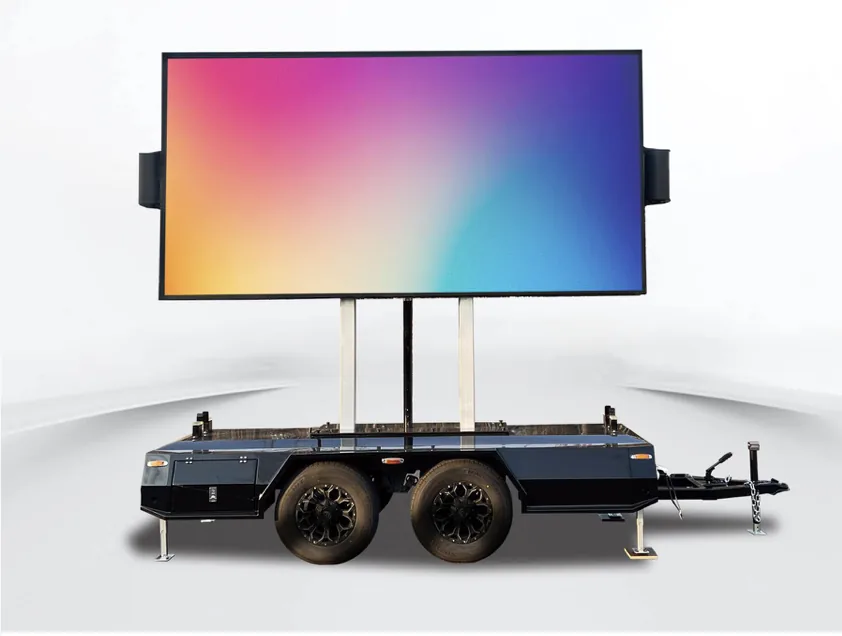
Where most first trailers land. Single and tandem axle, bumper-pull, one-person setup in 10 to 15 minutes.
MB-5 LiteFrom $30,0009.84' x 4.92' · The entry point. Single-axle starter trailer with real MOBO hydraulics.
MB-7 LiteFrom $39,50011.48' x 6.56' · Lite Series towing with a 75 sq ft screen. The community-event sweet spot.
MB-5Built to order10' x 5' · Gloss-black deluxe body with onboard speakers and amp.
MB-5DFrom $36,500Two 9.84' x 4.92' · Two faces on one mast. Double the impressions from a single tow.
MB-7DBuilt to orderTwo 12.6' x 6.3' · Two 12.6' x 6.3' faces back to back. Large-format double-sided advertising.
The big screens
Flatbed and enclosed chassis for festival mains, stadium lots and stadium-scale IMAG, without a semi truck.
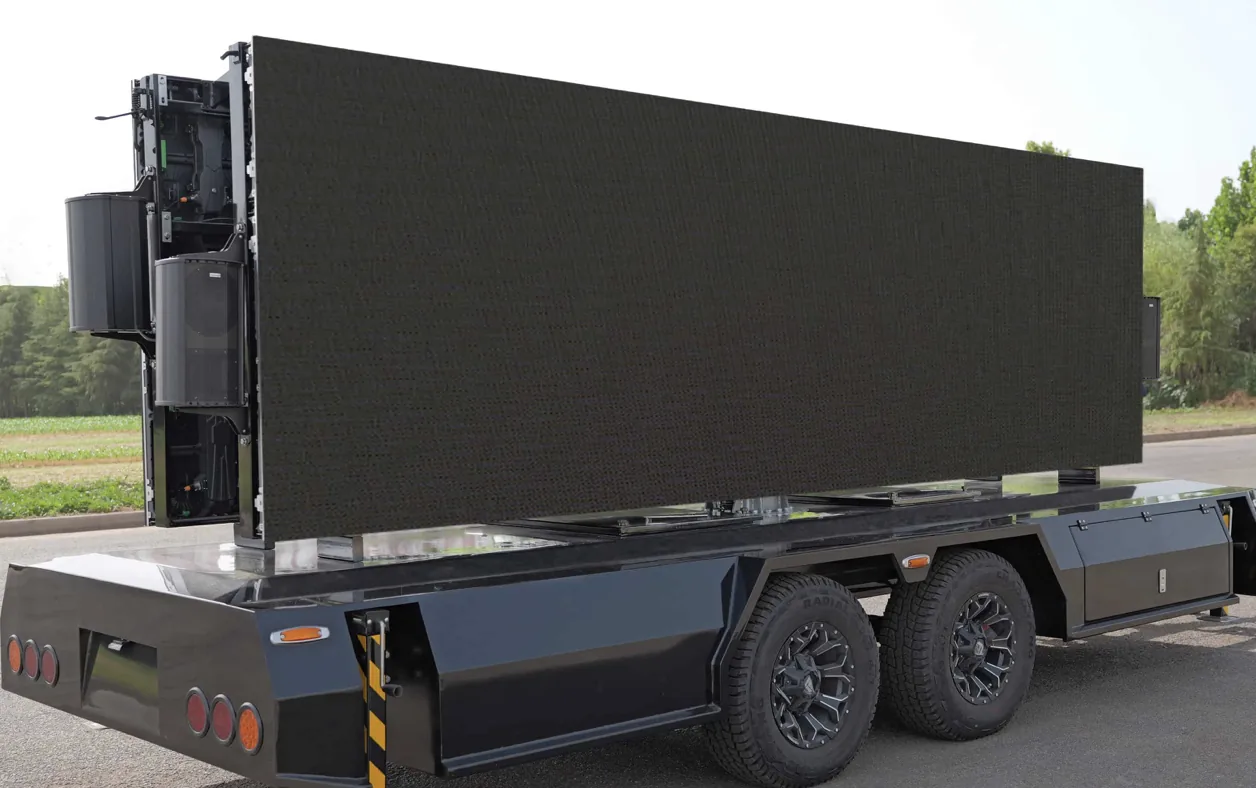
MB-22From $110,00020' x 11.5' · 230 sq ft flatbed screen for festival fields and stadium lots.
MB-28From $130,00023' x 13' · The flagship flatbed. ~300 sq ft for headline stages.
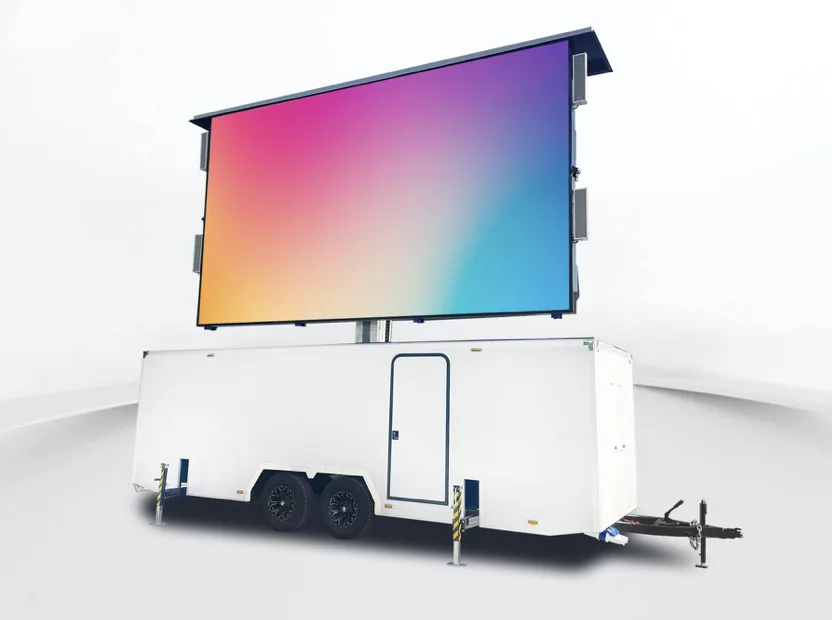
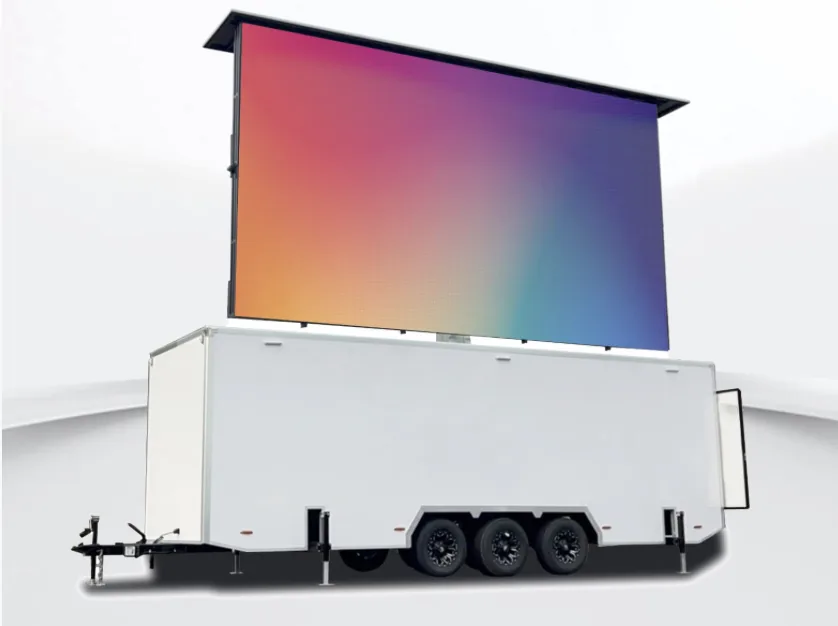
MB-22EFrom $120,00020' x 11.5' · The 20' x 11.5' screen in an enclosed body. Touring and fleet favorite.
MB-28EFrom $140,00023' x 13' · Flagship of the enclosed line, fully weather-sealed.
MB-60EBuilt to order33' x 20' · Stadium-class jumbotron. ~660 sq ft, 37.8 ft lift, SDI input.
Frequently asked
If your question is not here, call or use the quote form and we will answer it straight.
For a crowd around 500 at a community event, 75 to 108 square feet of screen is the usual answer, which is the MB-7 Lite at 11.48 by 6.56 feet or the MB-10 at 13.12 by 8.2 feet. The deciding factor is not the headcount itself but how far back the last row sits. A tight crowd of 500 in a school courtyard needs less screen than 500 spread across a park lawn.
A practical planning rule for legible content is about 4 to 6 times the screen height for the comfortable viewing zone, with the far limit around 10 times screen height before detail stops reading. A 10-foot-tall screen therefore serves a comfortable zone out to roughly 40 to 60 feet and remains watchable to around 100 feet for large content. Full brightness outdoor LED stays visible in direct sunlight, which is the real advantage over projection; projection needs darkness, LED does not.
No. Screen area drives price, tow weight, tow vehicle class, setup footprint and storage, and the biggest screen in the line needs a site that can actually accommodate it. The right size is the one that covers your largest regular event with a little headroom, not your largest imaginable event. If a genuinely huge job comes along once a year, rent for that one and own for the rest.
Pixel pitch should be chosen against your minimum viewing distance, not your maximum. If your nearest viewers stand 25 or 30 feet back, a coarser pitch is invisible to them and the money is better spent on screen area. If the screen carries broadcast IMAG with cameras pointed at it, or viewers stand within 10 or 15 feet, tighter pitch earns its cost. Tell us the closest viewer distance and whether cameras are involved and we will spec it.
For cost-per-square-foot comparison, yes, and that is why the MB-5D is the cheapest square footage in the line. For audience coverage, no. Each face serves the audience in front of it. A double-sided trailer is the right answer when you have two audiences, such as a roadside position between two traffic directions, and the wrong answer when you have one crowd and would rather have all your pixels facing it.
The single-axle Lite models tow behind a half-ton pickup. The tandem-axle MB-10 and MB-15 want a three-quarter-ton. The flatbed and enclosed models step up from there. Get the specific weight ratings with your quote and confirm them against the truck you actually own before you commit to a screen size, because the tow vehicle is often what decides it.
Get it right the first time
Describe your three biggest events: crowd size, how far back the last row sits, day or night, and whether cameras are involved. We will tell you which model fits and which one you would regret.
info@fullblastsound.com · San Antonio, TX
Important notice
The information on this page is provided for general educational and informational purposes only. It is not legal, tax, accounting, financial, insurance or other professional advice, and it is not an offer of credit or a solicitation. Fullblast Sound & Lights is an equipment dealer; we are not attorneys, accountants, tax advisors or lenders, and nothing here creates a professional or advisory relationship.
Laws, tax figures, regulations, local ordinances, licensing requirements, lender terms and third-party prices change and vary by jurisdiction and by individual circumstances. You should independently verify anything on this page and consult your own attorney, accountant, tax advisor, insurance agent and lender before acting on it. Figures attributed to our financing partner are theirs, and approval is never guaranteed. Prices and specifications are subject to change and are not an offer.
Nothing on this page is a projection, forecast, guarantee or representation of revenue, income, profit, savings or return. Results from operating equipment depend on factors outside our knowledge or control and vary widely. Fullblast Sound & Lights accepts no liability for decisions made in reliance on this page.