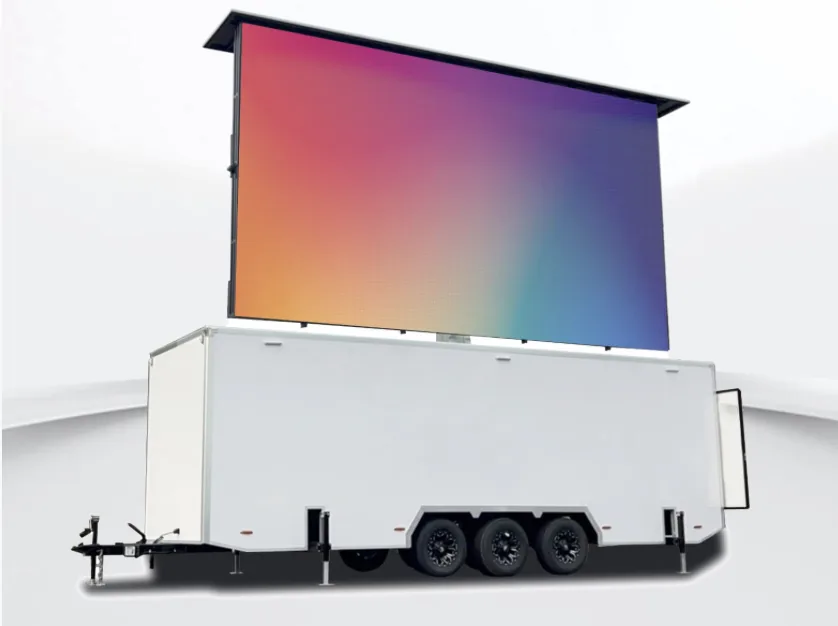
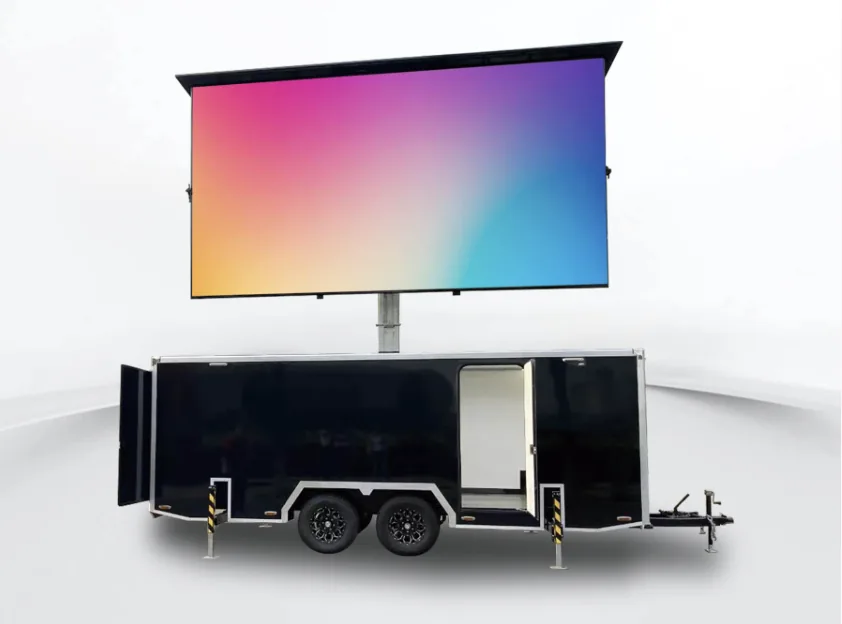
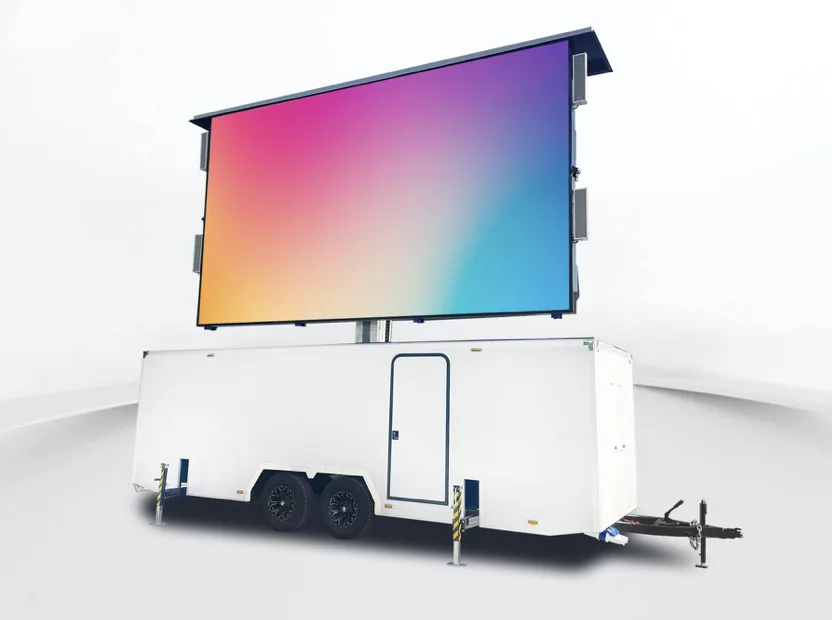
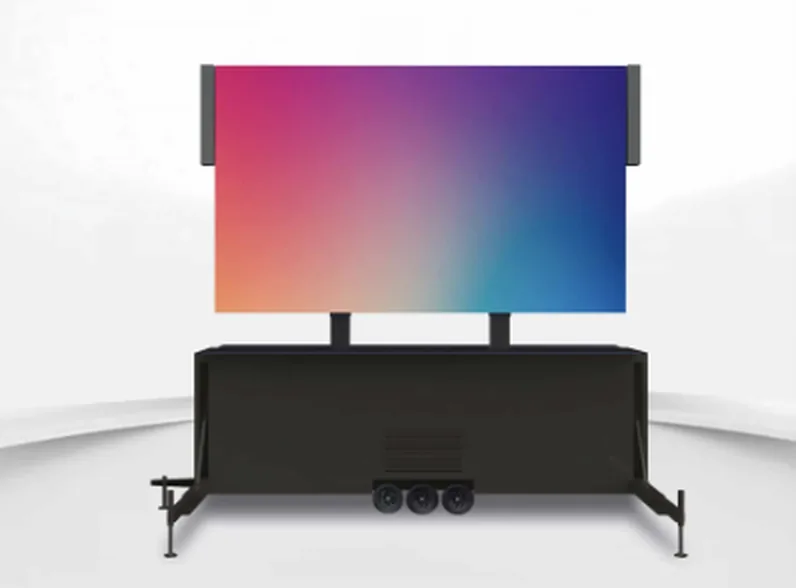
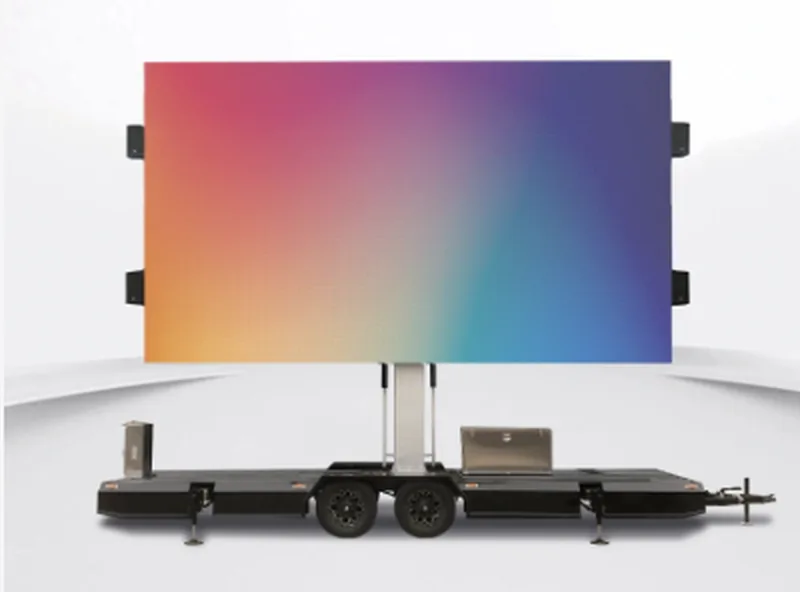
An enclosed trailer puts the same screen inside a weather-sealed body for roughly $10,000 to $15,000 more. That premium is either the best money you will spend on the trailer or money you did not need to spend, and which one depends almost entirely on your climate, your storage and how many days a year the trailer is on the road.
The premium, precisely
Three screen sizes in the MOBO line are offered both ways, which makes the premium unusually easy to read. Same screen dimensions, same deployed picture, different body.
| Screen | Open model | Enclosed model | Premium |
|---|---|---|---|
| 17' x 10' | MB-15: from $75,000 | MB-15E: from $90,000 | $15,000 |
| 20' x 11.5' | MB-22: from $110,000 | MB-22E: from $120,000 | $10,000 |
| 23' x 13' | MB-28: from $130,000 | MB-28E: from $140,000 | $10,000 |
On a trailer financed over 60 months, a $10,000 premium is a small share of the monthly payment. Set against a screen that is the single most expensive component on the trailer and the hardest to repair in the field, the enclosed body is best understood as insurance you buy once rather than a feature you pay for. Whether you need that insurance is the actual question.
What you are actually buying
A trailer spends a few hours deployed and the rest of its life in transit or parked. The enclosed body is about those hours, not the show.
Threat 01
Seventy miles an hour into rain, road grit and gravel strike is harder on a display than any event. An enclosed body means the screen travels inside a closed structure instead of facing the weather at speed.
Threat 02
If the trailer lives in a yard rather than a building, the enclosed body is the building. Months of sun on panel faces, seals and cabling add up, and UV degradation is cumulative and irreversible.
Threat 03
Coastal humidity corrodes connectors and desert dust finds its way into every ventilation path. Both are slow failures that show up as intermittent panels two years later, and both are what sealing prevents.
Threat 04
Hail is a single-event catastrophic risk to an exposed panel array. Repeated freezing and thawing works on seals, fasteners and hydraulic fittings. Neither is a concern you can manage with a tarp.
Threat 05
A closed body is a meaningful deterrent. An exposed screen in a parking lot overnight is an invitation, and the deductible on a vandalized panel array is not a pleasant conversation with your insurer.
Threat 06
If the trailer is out 100-plus days a year, every threat above compounds. Fleet operators and touring users buy enclosed because the arithmetic of downtime is worse than the arithmetic of the premium.
Decide
Count how many of these are true for you.
Three or more true: buy the enclosed model, and do not agonize over the premium. One or none true, with covered storage and mostly local work in a mild climate: the open trailer is the right buy and the money is better spent on screen area or a generator package. Exactly two: call us and we will talk through which two, because not all of them carry the same weight.
One last consideration that is easy to miss. If the enclosed premium would force you down a screen size, think hard. A larger open trailer that fits your audience will usually serve you better than a smaller enclosed one that does not, because a screen that is too small is a problem at every single event, while weather exposure is a problem that plays out over years. Get the size right first, then decide on the body.
Enclosed models
Weather-sealed bodies from 170 to 660 square feet of screen. Built for fleets, touring, and equipment that has to last a decade.
MB-15EFrom $90,00017' x 10' · The 17' x 10' screen inside a weather-sealed enclosed body.
MB-22EFrom $120,00020' x 11.5' · The 20' x 11.5' screen in an enclosed body. Touring and fleet favorite.
MB-28EFrom $140,00023' x 13' · Flagship of the enclosed line, fully weather-sealed.
MB-60EBuilt to order33' x 20' · Stadium-class jumbotron. ~660 sq ft, 37.8 ft lift, SDI input.
All 15 MOBO modelsFull lineupEvery trailer, golf cart, and solar unit with specs, downloads, and pricing.
Frequently asked
If your question is not here, call or use the quote form and we will answer it straight.
Same screen, different body. On an open trailer the display and the hydraulic mast sit on an exposed chassis. On an enclosed trailer they live inside a weather-sealed body that closes around them for transit and storage. The screen technology and the deployed picture are the same; what changes is how much weather, road debris, dust and UV the equipment sees across its service life.
On matched pairs in the MOBO line the enclosed body adds roughly $10,000 to $15,000. The MB-15 starts at $75,000 against $90,000 for the MB-15E, the MB-22 starts at $110,000 against $120,000 for the MB-22E, and the MB-28 starts at $130,000 against $140,000 for the MB-28E. You are not buying more screen for that money, you are buying protection and service life.
Not for rain alone. Outdoor LED screens are built to operate in weather, and an open trailer handles ordinary rain in deployment. The enclosed body matters for the other 95% of the trailer's life: highway transit at 70 mph in a storm, months parked outdoors, salt air, blowing sand, hail, and freeze-thaw cycling on connectors and hydraulics. It is a longevity and transit decision more than a rain decision.
Coastal salt air, desert dust and sand, hail country, and anywhere with hard freeze-thaw cycling. Also any operation that stores the trailer outdoors year-round regardless of climate, and any operation that tows long distances frequently. Mild climates with covered storage and mostly local work are where an open trailer makes clear sense.
Setup remains a one-person hydraulic operation with no tools; the enclosed models run about 20 minutes against roughly 15 for the mid-size open trailers, because the body has to open before the mast lifts. Deployed picture quality is a function of the LED and the pixel pitch, not the body, so an MB-15E and an MB-15 put the same image in the air.
Generally the enclosed unit holds value better, for the same reason it costs more: a screen that has spent its life protected from weather and transit is worth more than one that has not, and a buyer can see the difference. We would not buy an enclosed trailer purely for resale, but if you are choosing between them and expect to sell in five to seven years, it belongs in the calculation.
Decide with real numbers
Tell us your region, your storage situation and roughly how many days a year the trailer will be out. We will quote the open and the enclosed version of the same screen so the premium is a number you can look at rather than a guess.
info@fullblastsound.com · San Antonio, TX
Important notice
The information on this page is provided for general educational and informational purposes only. It is not legal, tax, accounting, financial, insurance or other professional advice, and it is not an offer of credit or a solicitation. Fullblast Sound & Lights is an equipment dealer; we are not attorneys, accountants, tax advisors or lenders, and nothing here creates a professional or advisory relationship.
Laws, tax figures, regulations, local ordinances, licensing requirements, lender terms and third-party prices change and vary by jurisdiction and by individual circumstances. You should independently verify anything on this page and consult your own attorney, accountant, tax advisor, insurance agent and lender before acting on it. Figures attributed to our financing partner are theirs, and approval is never guaranteed. Prices and specifications are subject to change and are not an offer.
Nothing on this page is a projection, forecast, guarantee or representation of revenue, income, profit, savings or return. Results from operating equipment depend on factors outside our knowledge or control and vary widely. Fullblast Sound & Lights accepts no liability for decisions made in reliance on this page.