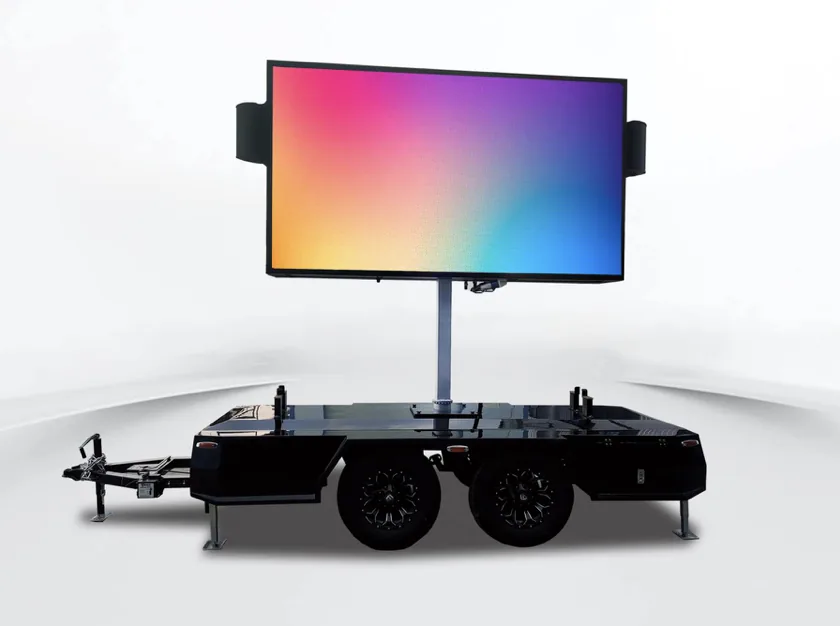
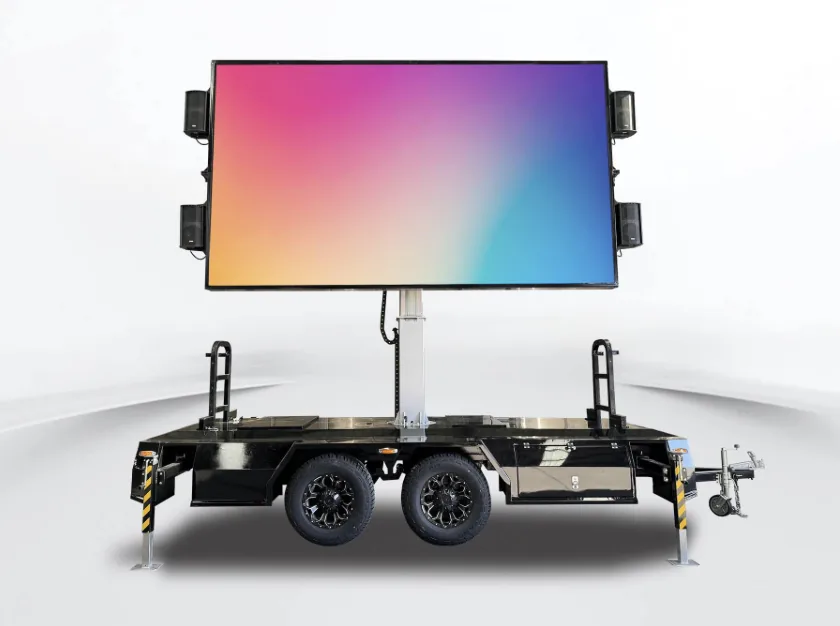
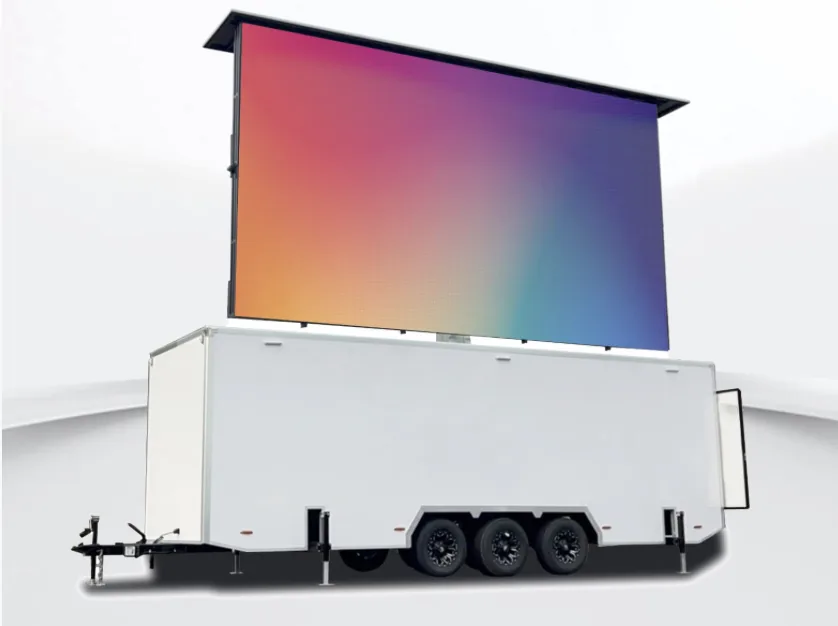
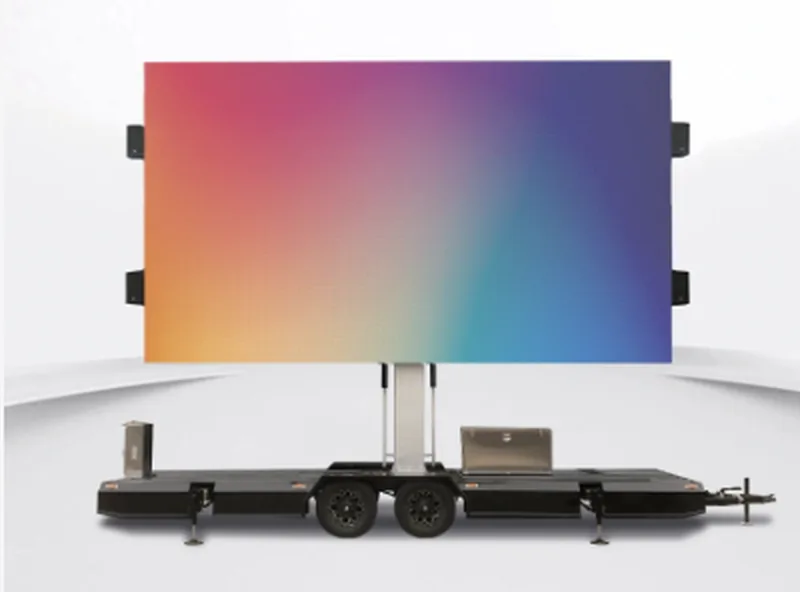
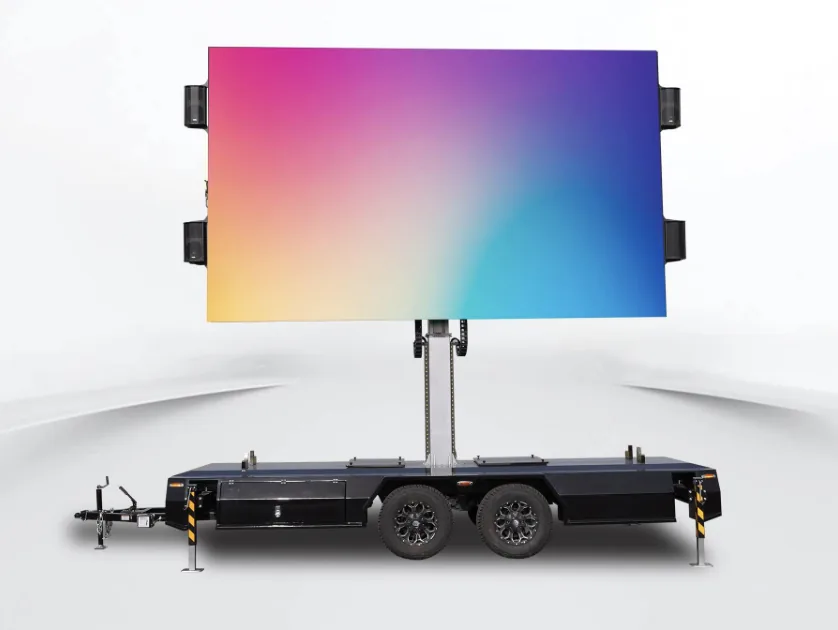
A mobile LED screen trailer runs from about $30,000 for a single-axle starter unit to $140,000 for a 23 by 13 foot enclosed trailer, with the stadium-class jumbotron and specialty builds priced to order above that. Below is every model we sell with its published starting price, the cost per square foot of screen so you can compare honestly, and the ownership costs that a purchase price never includes.
Every model, priced
These are our published starting prices as an authorized US MOBO dealer, current as of September 2026. The last column divides the starting price by the screen area so you can compare models on the only metric that is consistent across the line: what you pay per square foot of LED.
| Model | Series | Screen | Sq ft | Starting price | Per sq ft |
|---|---|---|---|---|---|
| MB-5 Lite | Lite | 9.84' x 4.92' | 48 | From $30,000 | $625 |
| MB-7 Lite | Lite | 11.48' x 6.56' | 75 | From $39,500 | $525 |
| MB-5 | Deluxe | 10' x 5' | 50 | Built to order | Single configuration |
| MB-5D | Deluxe | Two 9.84' x 4.92' | 97 | From $36,500 | $375 |
| MB-7D | Deluxe | Two 12.6' x 6.3' | 159 | Built to order | Single configuration |
| MB-10 | Deluxe | 13.12' x 8.2' | 108 | From $55,000 | $510 |
| MB-15 | Deluxe | 17' x 10' | 170 | From $75,000 | $440 |
| MB-22 | Flatbed | 20' x 11.5' | 230 | From $110,000 | $480 |
| MB-28 | Flatbed | 23' x 13' | 299 | From $130,000 | $435 |
| MB-15E | Enclosed | 17' x 10' | 170 | From $90,000 | $530 |
| MB-22E | Enclosed | 20' x 11.5' | 230 | From $120,000 | $520 |
| MB-28E | Enclosed | 23' x 13' | 299 | From $140,000 | $470 |
| MB-60E | Enclosed | 33' x 20' | 660 | Built to order | Single configuration |
| SAT-3 Solar | Specialty | 8.4' x 4.2' | 35 | Built to order | Single configuration |
| LED Golf Cart | Specialty | Custom sizes | Custom | Built to order | Single configuration |
Cost per square foot of screen falls by roughly a third as you move up the line, from about $625 per square foot on the MB-5 Lite to about $435 on the MB-28. The chassis, mast, hydraulics, control system and bodywork cost about the same regardless of how much LED they carry, so the screen gets cheaper per foot the more of it you buy. That argues for buying the largest trailer your tow vehicle, your storage and your actual event calendar can justify, not the largest one you can finance.
Where the money goes
Two trailers with the same screen dimensions can be $30,000 apart. These are the variables that explain the gap.
Driver 01
The single biggest factor. LED is sold by the panel, and panels are the most expensive thing on the trailer. Going from the MB-10's 108 square feet to the MB-15's 170 adds about $20,000 at our published starting prices.
Driver 02
Tighter pixel pitch means more LEDs per square foot and a higher price. It also means a cleaner image closer up. For an audience standing 30 feet back, a tight pitch is money spent on resolution nobody can resolve. For a screen carrying broadcast IMAG with cameras pointed at it, it is not.
Driver 03
An enclosed body runs roughly $10,000 to $15,000 over the open version of the same screen: MB-15 at $75,000 versus MB-15E at $90,000, MB-28 at $130,000 versus MB-28E at $140,000. You are buying weather sealing and a longer service life, not more screen.
Driver 04
Double-sided models put a second screen on the same mast. The MB-5D delivers 97 square feet across two faces from $36,500, which is the cheapest square footage in the line, because the chassis is shared. For advertising routes where the trailer is parked between two traffic directions, it is the obvious buy.
Driver 05
Shore power is free; self-contained operation is not. A super-silent onboard inverter or diesel generator is an option on every model, and on the SAT-3 the entire power system is rooftop solar and batteries. If every event you book has 50-amp service at the pad, you can skip it.
Driver 06
Trailers ship from the factory and freight is real money on a 23-foot flatbed. Audio packages, SDI input for broadcast, wraps, spare panels, and content playback hardware all sit on top of the base price. We quote these explicitly rather than burying them.
Every one of these is a decision you make once and live with for a decade. We would rather spend an hour on the phone getting it right than sell you the wrong trailer quickly.
Beyond the purchase price
The purchase price is the number everybody asks about. These are the ones that decide whether the trailer makes money. We are not going to invent dollar figures for your situation, because insurance in Florida and insurance in Ohio are not the same number and a quote takes ten minutes to get. But you should have every one of these priced before you sign.
Single-axle Lite models tow behind a half-ton pickup. The tandem-axle MB-10 and MB-15 want a three-quarter-ton. The flatbed and enclosed models step up from there. If you do not already own the right truck, that is part of the project cost, and it is often the second-biggest line item.
You generally need two things: commercial auto coverage that extends to a towed trailer, and an inland marine or equipment floater policy covering the LED itself, which is the expensive part and is not covered the way a cargo trailer would be. Venues and municipalities will also ask for a certificate of insurance with specific limits before they let you on site, so the coverage you buy is partly determined by the clients you want.
A 23-foot trailer with a folded mast does not fit in a standard storage unit and often does not fit under a carport. Covered storage protects the screen and the hydraulics and extends the life of both. Price it locally before you buy, because it is a recurring cost for the life of the trailer.
An MB-10 averages around 3 kW running normal content, far below its maximum draw. If you run shore power, that cost is usually the venue's. If you run a generator, fuel is yours, and it scales with how many hours the screen is lit.
If you are selling advertising, somebody has to build the creative and schedule the loop. That is either your time, a contractor, or a software subscription. Operators who treat content as an afterthought tend to discover their clients care about it a great deal.
Tires, bearings, brakes and hydraulic service on the trailer side; occasional panel and power-supply replacement on the screen side. Spare panels from the same production batch are worth buying with the trailer, because color-matching a panel bought three years later is a genuine problem.
Build a simple annual operating budget with these six lines filled in with real local quotes before you commit to a purchase price. If the trailer still works at those numbers, buy it with confidence. If it only works when you leave three of them blank, the trailer is not the problem, the plan is.
Figures reported by Providence Capital Funding. Approval is not guaranteed.
Paying for it
Most trailers in this category are financed rather than bought outright, for a straightforward reason: the trailer is revenue equipment, and financing lets the revenue start before the capital is gone. Business financing through Providence Capital Funding starts at $5,000, credit decisions typically come back in 24 to 48 hours, there is no application fee, and the first payment can be deferred 60 to 90 days, so a trailer delivered in October can be booking work before the first payment is due.
A $65,000 trailer financed over 60 months typically runs roughly $1,300 to $1,550 per month. That figure is estimated for illustration only. Your actual rate and payment are set by the lender based on your credit profile and term, and lease terms run 12 to 72 months, up to 84 for some programs.
Two things worth understanding before you compare a payment to a purchase price. First, a financed trailer placed in service by December 31 may still qualify for the full Section 179 deduction in that tax year even though you have only made a payment or two, which is why the fourth quarter is the busiest buying season in equipment sales. Second, the interest you pay is the price of keeping working capital in the business; whether that trade is worth it depends on what else that capital would have earned.
All financing figures are reported by Providence Capital Funding and are subject to their credit approval, which is not guaranteed. Payment examples are estimates for illustration only and are not an offer of credit. We are not a lender.
The other half of the question
It depends entirely on how many days a year you need a screen, and the honest answer for a lot of buyers is that renting is the right call. Rather than assert a break-even number here, we went and collected what mobile LED screen operators actually publish for rental rates, with links to each source, and worked the arithmetic both directions.
Priced models
Starting prices shown. Every model is quoted to your configuration, with freight and financing included in the conversation.
MB-5 LiteFrom $30,0009.84' x 4.92' · The entry point. Single-axle starter trailer with real MOBO hydraulics.
MB-10From $55,00013.12' x 8.2' · The workhorse. 100+ sq ft, 18 ft lift, onboard audio.
MB-15From $75,00017' x 10' · 160+ sq ft for festivals and broadcasts, still bumper-pull.
MB-28EFrom $140,00023' x 13' · Flagship of the enclosed line, fully weather-sealed.
All 15 MOBO modelsFull lineupEvery trailer, golf cart, and solar unit with specs, downloads, and pricing.
Frequently asked
If your question is not here, call or use the quote form and we will answer it straight.
MOBO mobile LED screen trailers start at $30,000 for the MB-5 Lite, a single-axle trailer with a 9.84 by 4.92 foot screen. The MB-10 with a 13.12 by 8.2 foot screen starts at $55,000, the 17 by 10 foot MB-15 starts at $75,000, and the 23 by 13 foot enclosed MB-28E starts at $140,000. The MB-60E jumbotron, the MB-5, MB-7D, SAT-3 solar unit and the LED golf cart are built to order and priced per configuration. Prices are starting points before options and freight.
Because the chassis, hydraulic mast, control system, wiring and bodywork cost roughly the same whether they carry 48 square feet of screen or 300. On our published starting prices the MB-5 Lite works out to roughly $625 per square foot of screen while the MB-28 is closer to $435. If your only constraint is dollars per square foot, the bigger trailer wins; if your constraint is tow vehicle, storage, or the size of the events you actually book, it does not.
A trailer price covers the trailer. Budget separately for a tow vehicle rated for the weight, insurance (inland marine or equipment floater plus commercial auto), freight from the factory, storage that fits a trailer with a mast, fuel if you run a generator, content creation or a playback subscription if you are selling advertising, and routine maintenance on tires, bearings, brakes and hydraulics. None of those are exotic, but they are real, and they are the line items buyers forget.
Sometimes, with two cautions. LED panels degrade and the older the display the more likely you are buying dead pixels, mismatched panel batches, or a pixel pitch that looks dated on camera. Second, hydraulics and DOT-critical parts on a trailer that has been deployed hundreds of times need real inspection. Used equipment still qualifies for Section 179 if it is new to your business. If you are comparing a used unit against a new one, send us the listing and we will tell you straight whether the price makes sense.
Yes. Business financing through Providence Capital Funding starts at $5,000, credit decisions typically come back in 24 to 48 hours, there is no application fee, and the first payment can be deferred 60 to 90 days. Installation, freight and soft costs can be bundled into the lease. Approval is not guaranteed and terms are set by the lender.
A business-use cargo or utility trailer is treated as ordinary equipment rather than as a vehicle subject to the SUV or luxury-auto limits, so it can qualify for Section 179 up to the general 2026 limit of $2,560,000 set by IRS Revenue Procedure 2025-32, provided business use exceeds 50% and the trailer is placed in service during the tax year. Financed equipment can qualify. Section 179 is also capped by your business's taxable income and state treatment varies. This is general information, not tax advice; confirm with your tax advisor.
Pricing your trailer
Starting prices get you in the ballpark. A quote gets you the number. Tell us the screen size, the configuration, and where it is going, and we will price it including freight, and line up financing if you want it.
info@fullblastsound.com · San Antonio, TX
Important notice
The information on this page is provided for general educational and informational purposes only. It is not legal, tax, accounting, financial, insurance or other professional advice, and it is not an offer of credit or a solicitation. Fullblast Sound & Lights is an equipment dealer; we are not attorneys, accountants, tax advisors or lenders, and nothing here creates a professional or advisory relationship.
Laws, tax figures, regulations, local ordinances, licensing requirements, lender terms and third-party prices change and vary by jurisdiction and by individual circumstances. You should independently verify anything on this page and consult your own attorney, accountant, tax advisor, insurance agent and lender before acting on it. Figures attributed to our financing partner are theirs, and approval is never guaranteed. Prices and specifications are subject to change and are not an offer.
Nothing on this page is a projection, forecast, guarantee or representation of revenue, income, profit, savings or return. Results from operating equipment depend on factors outside our knowledge or control and vary widely. Fullblast Sound & Lights accepts no liability for decisions made in reliance on this page.