DEALER  /  MEYER SOUND  /  BASSBOSS  /  HSD  /  LIGHTING  /  AVANTE  /  MOBO  /  GLOBAL TRUSS
Call 210.489.0492
Advertising Models

Double-Sided LED Trailers for Roadside Advertising

A double-sided trailer carries two screens on one mast, one chassis and one tow. For a roadside advertising position between two directions of traffic, that is not a marginal improvement, it is the difference between selling half the traffic and all of it. It is also the cheapest screen area in the MOBO line.

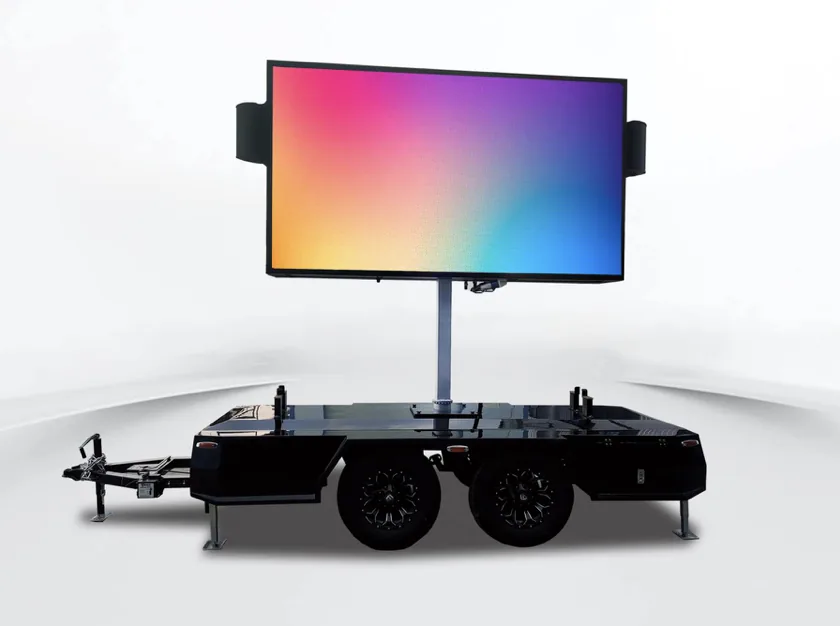
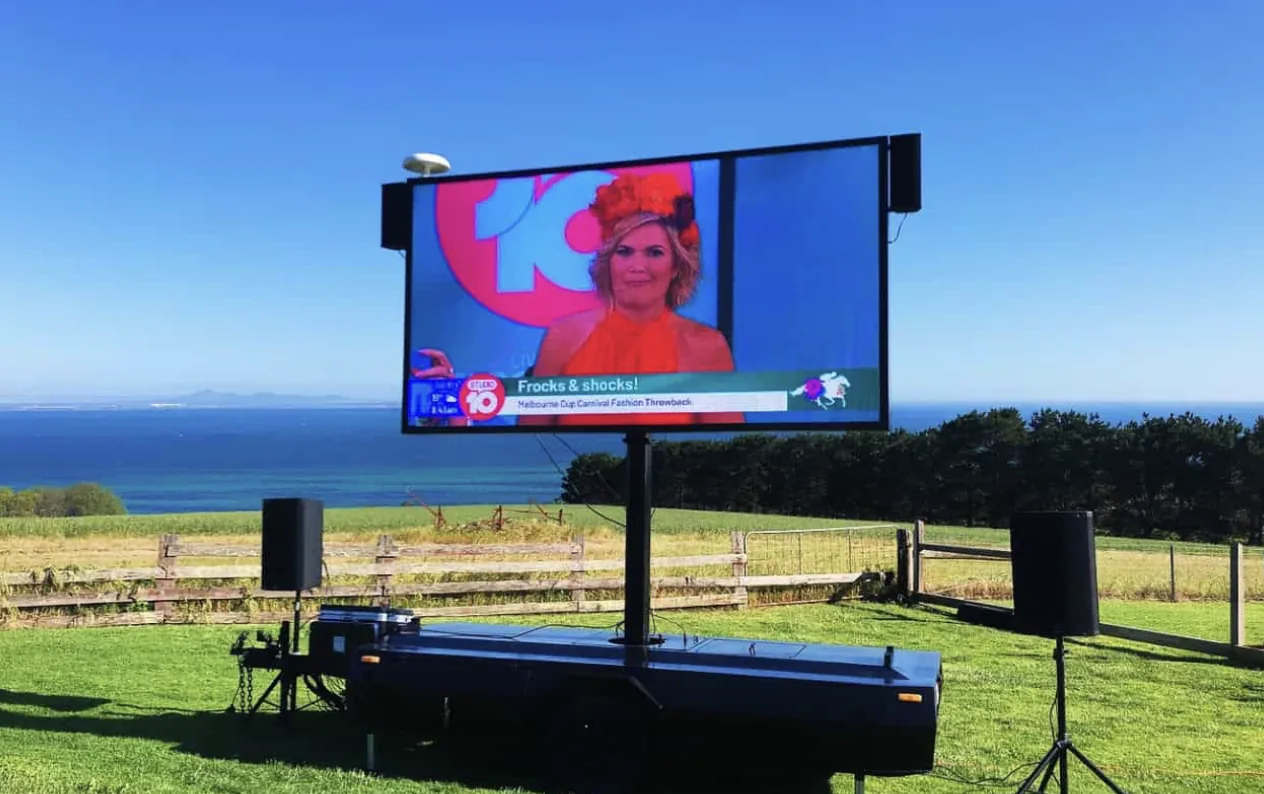
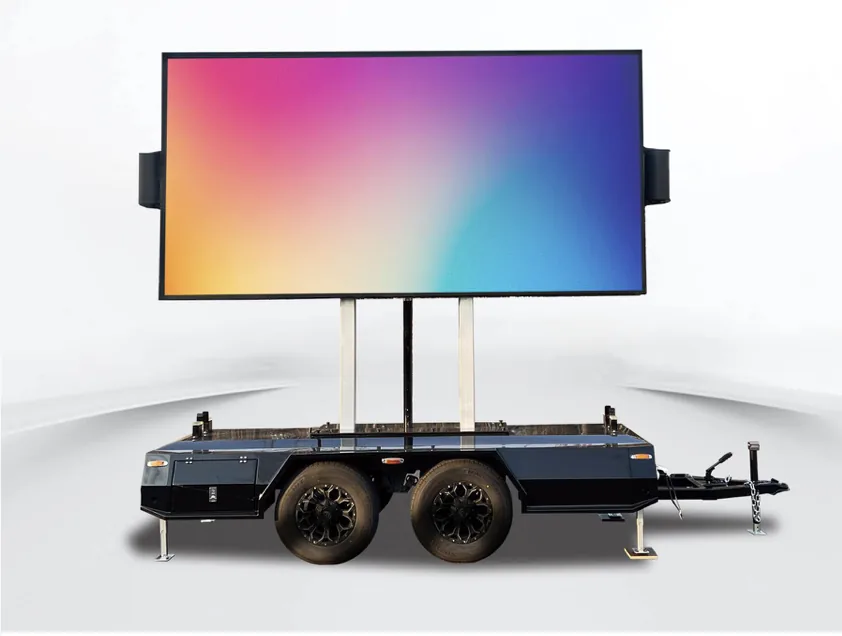
MOBO MB-5D double-sided mobile LED advertising trailer

The cost case

Two faces are the cheapest screen area in the line

The chassis, hydraulic mast, control system, wiring and bodywork cost roughly the same whether they carry one screen or two. Put a second face on the same mast and you pay close to the marginal cost of panels for a second audience. That shows up clearly when you compare cost per square foot across the line.

Cost per square foot calculated from our published starting prices and the published screen dimensions, counting both faces on double-sided models. Starting prices are before options, freight and tax.
ModelConfigurationTotal screenStarting pricePer sq ft
MB-5DTwo 9.84' x 4.92' faces97 sq ftFrom $36,500About $375
MB-5 LiteSingle 9.84' x 4.92' face48 sq ftFrom $30,000About $625
MB-7 LiteSingle 11.48' x 6.56' face75 sq ftFrom $39,500About $525
MB-10Single 13.12' x 8.2' face108 sq ftFrom $55,000About $510
MB-7DTwo 12.6' x 6.3' faces159 sq ftBuilt to orderQuoted
Read it carefully

The MB-5D gives you roughly twice the screen area of the MB-5 Lite for $6,500 more. That is the strongest value proposition in the MOBO line on a pure square-footage basis. It is only the right buy if you have two audiences, though. Ninety-seven square feet split across two faces is not the same product as 97 square feet facing one crowd, and no amount of cost-per-foot arithmetic changes that.

Where two faces win

The positions that justify a second screen.

Every one of these has the same structure: two streams of viewers moving in opposite directions past a single spot you can legally park in.

Position 01

Divided roadway frontage

Parked between two directions of traffic, both faces work simultaneously from one position and one tow. This is the archetypal double-sided placement and the reason the configuration exists.

Position 02

Event ingress and egress

A single position at a venue entrance catches arriving traffic on one face and departing traffic on the other, across the whole event window rather than just one half of it.

Position 03

Parking lot aprons

Shopping centre and dealership frontage where pedestrians approach from the lot and vehicles pass on the street. Two different audiences, two different messages, one parking space.

Position 04

Shared advertiser loops

Two faces let two advertisers hold different directions at the same time, which changes what you can sell. Specify independent scheduling per face when you order if this is your model.

Position 05

Tailgates and game-day lots

Foot traffic circulating in both directions through a lot means a single face is dark to half of it at any moment. Two faces halve the number of positions you need to work.

Position 06

Parades and routed displays

A trailer in a parade or moving a route is seen from both sides of the street. One face means half the spectators see the back of your trailer.

And the counter-case, stated plainly: for a festival stage, a movie night, a watch party or any single seated crowd, put all your pixels on one face. The MB-15 at 17 by 10 feet will serve that audience far better than two smaller screens, half of which nobody is looking at.

Before you sell a placement

Check the ordinance for every position on your route

The trailer is the straightforward part: US DOT compliant, VIN that decodes in the NHTSA system, DOT-approved lighting, tires and couplers, electric brakes, breakaway kit. It titles and registers like any commercial trailer anywhere in the country.

Where you may park it and display advertising is an entirely separate question answered by local law, and the answers are not consistent. A number of US cities and counties specifically regulate mobile billboard advertising. The provisions we see most often restrict vehicles parked primarily to display advertising, cap how long such a vehicle may stay in one position, require a permit, or regulate brightness and operating hours for illuminated signage. Some prohibit the practice outright.

The practical discipline is simple. Before you sell a client a position, read the sign ordinance for that jurisdiction, and if the language is ambiguous, call code enforcement and ask directly. Get written permission for private property and confirm it does not conflict with the property's own sign restrictions or lease terms. A campaign shut down on day two costs you the refund and the client.

General business information, not legal advice. Sign ordinances and vehicle regulations vary by jurisdiction and change. Verify with the relevant local authority and your own attorney.

Advertising models

Double-sided and small-format advertising trailers.

Two-face models for roadside routes, single-face Lite models where one audience is all you need.

Frequently asked

Double-sided trailer questions.

If your question is not here, call or use the quote form and we will answer it straight.

What is a double-sided LED trailer?

A trailer with two LED screens mounted back to back on the same hydraulic mast, so the unit displays to two opposite directions at once from a single parking position. The MOBO MB-5D carries two 9.84 by 4.92 foot faces and starts at $36,500; the MB-7D carries two 12.6 by 6.3 foot faces and is built to order. Both deploy in about 10 to 15 minutes by one person with no tools.

Is a double-sided LED trailer worth the extra cost?

For roadside advertising, the arithmetic is unusually clear. The MB-5D delivers 97 square feet of screen across two faces from $36,500, which works out to roughly $375 per square foot, the lowest in the MOBO line, because the chassis, mast, hydraulics and control system are shared between the two screens. If your positions have traffic in two directions, you are buying the second audience at close to the marginal cost of the panels.

When is a single large screen better than two smaller ones?

Whenever you have one audience in one place. At a festival, a movie night, a stadium lot or a watch party, everyone is looking the same way, and a single 17 by 10 foot face on an MB-15 serves them far better than two 9.84 by 4.92 foot faces of which they can only see one. Double-sided is a roadside and route answer, not an event answer.

Can each side show different content?

That depends on the configuration and the playback setup, and it is worth specifying explicitly when you order rather than assuming. Operators who sell shared loops often want independent scheduling per face so two advertisers can hold different directions simultaneously. Tell us how you intend to sell the screen and we will confirm what the configuration supports.

Are double-sided advertising trailers legal to park roadside?

The trailer is DOT compliant and registers like any commercial trailer, but where you may park it to display advertising is governed by local sign ordinances, and those differ sharply between jurisdictions. Some cities restrict or prohibit vehicles parked primarily to display advertising, some cap duration in one position, some regulate brightness and hours for illuminated signs. Read the ordinance for every jurisdiction on your route before you sell a placement there. General information, not legal advice.

What tow vehicle does an MB-5D need?

The MB-5D is in the smaller end of the line and the Lite and small Deluxe models are generally half-ton towable, but confirm the specific weight ratings with your quote against the truck you actually own before you commit. Getting the tow rating wrong is the most common and most expensive planning mistake in this category.

Two faces, one tow

Price a double-sided trailer for your routes.

Tell us the positions you are working and which directions of traffic matter. We will tell you honestly whether two faces or one larger face serves you better, and quote accordingly.

info@fullblastsound.com  ·  San Antonio, TX

Important notice

The information on this page is provided for general educational and informational purposes only. It is not legal, tax, accounting, financial, insurance or other professional advice, and it is not an offer of credit or a solicitation. Fullblast Sound & Lights is an equipment dealer; we are not attorneys, accountants, tax advisors or lenders, and nothing here creates a professional or advisory relationship.

Laws, tax figures, regulations, local ordinances, licensing requirements, lender terms and third-party prices change and vary by jurisdiction and by individual circumstances. You should independently verify anything on this page and consult your own attorney, accountant, tax advisor, insurance agent and lender before acting on it. Figures attributed to our financing partner are theirs, and approval is never guaranteed. Prices and specifications are subject to change and are not an offer.

Nothing on this page is a projection, forecast, guarantee or representation of revenue, income, profit, savings or return. Results from operating equipment depend on factors outside our knowledge or control and vary widely. Fullblast Sound & Lights accepts no liability for decisions made in reliance on this page.
Newsletter

Deals, drops, and B-stock.

Pro audio specials, new gear launches, dealer-only pricing alerts, and Synchrony financing promos from Fullblast Sound. Sent only when there is something real.

Free to subscribe. Unsubscribe any time. No spam.

Call 210.489.0492
FBS Newsletter B-stock alerts, dealer specials, new product drops, financing offers. No spam.