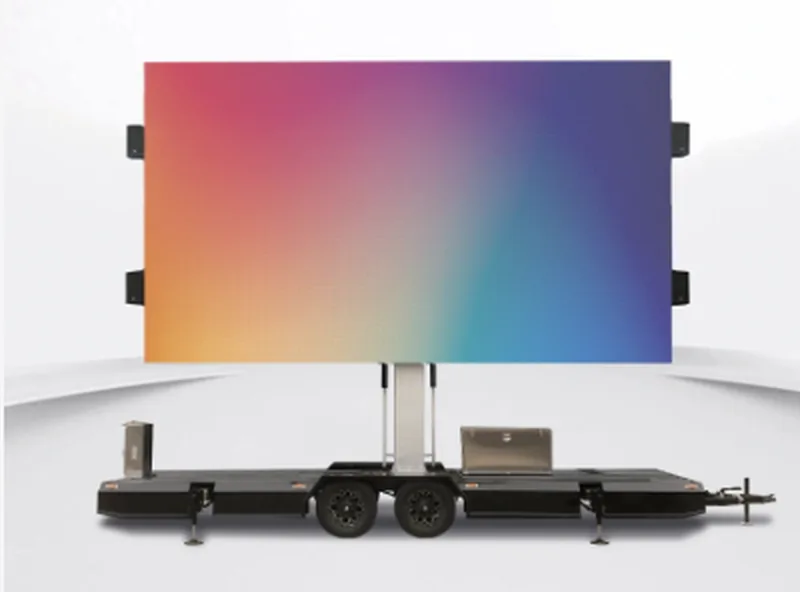
A mobile LED billboard business is one of the few advertising businesses you can start with a single asset and a truck. It is also a business where the equipment is the easy part: the trailer arrives working, and then you have to sell screen time, satisfy local sign ordinances, and keep a $55,000 asset busy. Here is the honest version of what that takes.
The sequence
The mistake we see most often is buying the trailer first and figuring out the demand afterwards. Steps one and two cost nothing and will tell you whether steps three onward are worth taking.
Step 01
Talk to twenty local businesses that already buy outdoor advertising: car dealers, dispensaries where legal, restaurants, event promoters, political campaigns, real-estate developers. Ask what they pay now and what would make a mobile screen worth it. Twenty conversations is a week of work and it is the cheapest market research you will ever do.
Step 02
Read the sign ordinance for every city and county on your intended route. Some jurisdictions restrict or prohibit mobile billboards outright, some limit parking duration for advertising vehicles, some require permits. Do this before you buy, because a route that is illegal is not a route.
Step 03
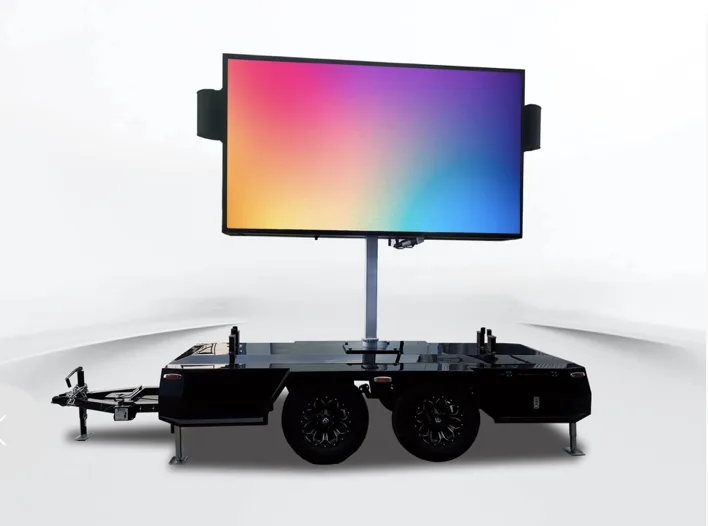
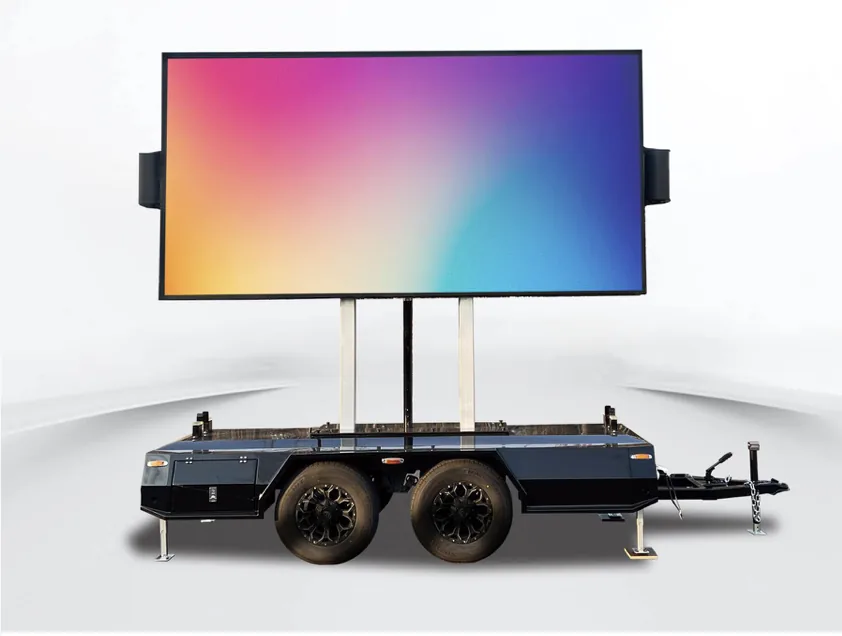
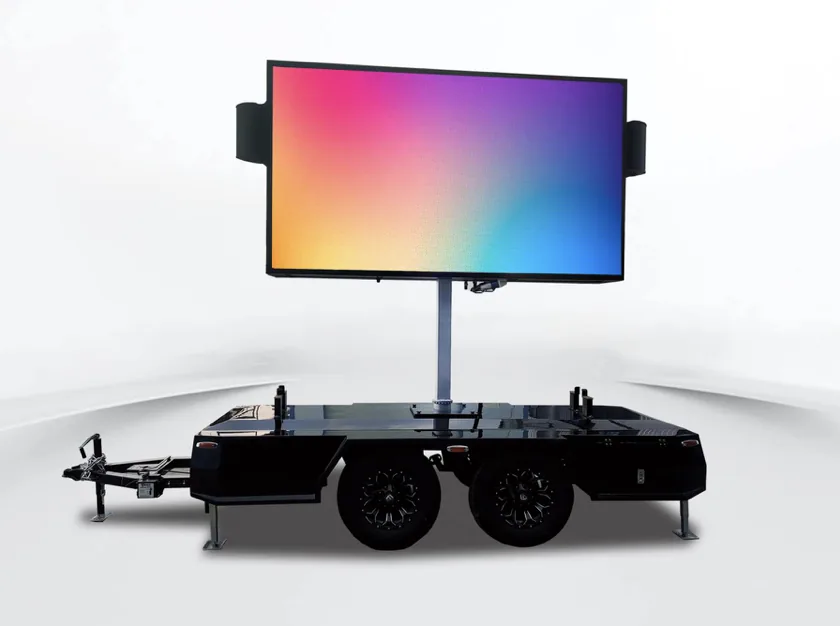
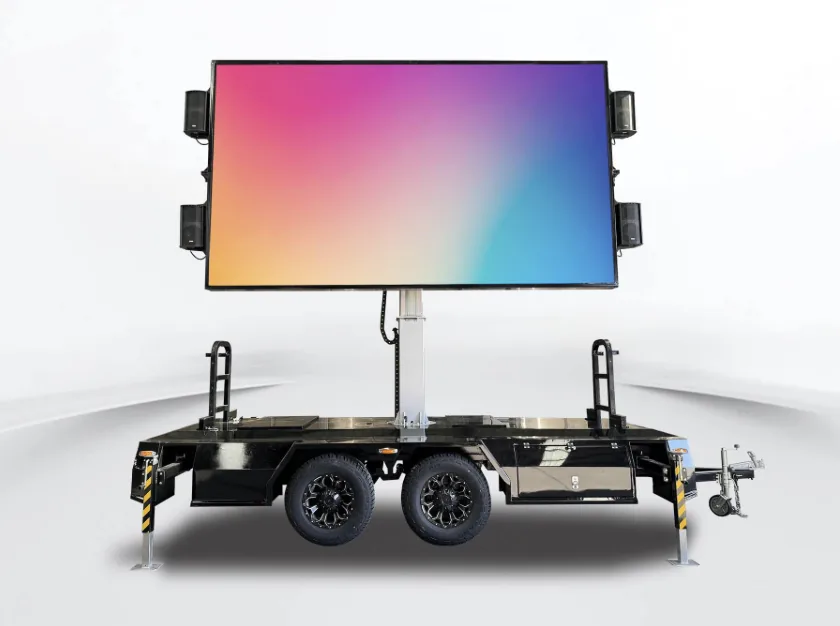
Roadside advertising in two traffic directions points to a double-sided model, the MB-5D from $36,500 or the larger MB-7D. Event and festival work points to a single large face, the MB-10 from $55,000 or the MB-15 from $75,000. Buy for the work you validated in step one.
Step 04
An LLC or corporation, commercial auto that extends to a towed trailer, and an inland marine or equipment floater covering the LED itself. Clients and venues will ask for a certificate of insurance, so the coverage you buy partly determines the clients you can serve.
Step 05
Business financing through Providence Capital Funding starts at $5,000, uses a one-page application with no application fee, and typically returns a credit decision in 24 to 48 hours. Startups may qualify. First payment deferrable 60 to 90 days means the trailer can be earning before payment one. Approval is not guaranteed.
Step 06
Day rate, weekly campaign rate, shared-loop rate, event rate. Write it down before your first sales call, because pricing invented on the phone is pricing you will regret. Base it on what local outdoor advertising costs, not on a national average.
Step 07
Somebody has to produce the creative and schedule the loop. Clients who hand you a logo and expect a finished spot are the norm, not the exception. Decide early whether that is billable work you do, a contractor you mark up, or a service you decline.
Step 08
The operators who do best rarely sell advertising alone. The same trailer runs outdoor movie nights, sports watch parties, festival IMAG, church services on the lawn, and municipal messaging. A trailer with two or three demand sources survives a slow advertising quarter.
Setup is one person in about 10 to 15 minutes on the models most advertising operators buy, which is what makes multiple placements in a single day practical.
What it costs to start
We can give you exact numbers for the trailer because we sell it. For everything else we will tell you what the line item is and insist you get a local quote, because insurance, storage and registration vary enormously by state and we are not going to invent a figure that shapes your business plan.
| Line item | What it is | Our number |
|---|---|---|
| Trailer | MB-5D double-sided, 97 sq ft across two faces | From $36,500 |
| Trailer, alternative | MB-5 Lite single face, the lowest entry cost | From $30,000 |
| Trailer, step up | MB-10, 108 sq ft, the workhorse of the line | From $55,000 |
| Freight | Factory delivery to you | Quoted per destination |
| Power package | Optional super-silent inverter or diesel generator for self-contained operation | Quoted per configuration |
| Tow vehicle | Half-ton for single-axle Lite models; three-quarter-ton for MB-10 and MB-15 | Your local market |
| Insurance | Commercial auto extending to a towed trailer, plus inland marine or equipment floater on the LED | Get two agent quotes |
| Entity and registration | LLC or corporation, trailer title and registration, local business license | Varies by state |
| Storage | Covered space that fits a trailer with a folded mast | Price before you buy |
| Content | Creative production and loop scheduling, in-house or contracted | Your time or a contractor |
| Working capital | Fuel, permits, sales time, and the months before receivables land | Be honest with yourself |
Working capital. A trailer financed with a 60 to 90 day deferred first payment gives you real runway, but advertising clients pay on their terms, not yours, and the first quarter is mostly sales calls. Operators who fail rarely fail because the trailer underperformed; they fail because they funded the asset and not the six months of selling it takes to fill it.
Figures reported by Providence Capital Funding. Approval is not guaranteed.
Charging for it
We are not going to publish a rate card for your business, and you should be suspicious of anyone who does. What we can do is tell you the four structures operators actually use and the one piece of market evidence that is genuinely useful.
For event work, you are competing with mobile LED screen rental operators, and some of them publish their rates. We collected the ones that do, with links and access dates, on our rent-versus-buy page. Published day rates for a 17 by 10 foot screen ranged from roughly $2,999 to $6,500 when we recorded them on September 21, 2026, usually including delivery, setup and an operator; the top of that range came from a national event-rental franchise in the Texas market and the bottom from the same franchise's Mountain West territory. That is not what you will charge, and it is not a forecast of your revenue. It is what the event market is currently paying somebody, published by the people charging it, which makes it a better starting point than a guess.
We will not tell you what your trailer will earn, and we would encourage you to distrust any dealer who does. Revenue in this business is a function of your market, your sales ability, your traffic positions, your competition and your utilization rate, and none of those are things a trailer ships with. Two operators can buy the identical trailer in the same month and have completely different years. Build your plan so it survives a bad first quarter.
Staying legal
Every MOBO trailer is US DOT compliant with a VIN that decodes in the NHTSA system, DOT-approved lighting, tires and couplers, electric brakes and a breakaway kit. It titles and registers like any commercial trailer. This is worth understanding as a buying criterion: a unit that cannot be registered in your state is not a cheaper trailer, it is a yard ornament.
Mobile billboard advertising is specifically regulated in a number of US cities and counties, and the rules are not uniform. Some jurisdictions prohibit advertising vehicles parked primarily to display advertising, some limit how long such a vehicle may remain in one place, some require a permit, and some regulate brightness and operating hours for illuminated signs. Read the actual ordinance for every jurisdiction you plan to work, and if the language is ambiguous, call the code enforcement office and ask. A client campaign shut down by a code officer on day two is a refund and a reputation problem.
Most good positions are private: shopping center aprons, restaurant lots, dealership frontage. Get written permission, confirm it does not violate the property's own sign restrictions or lease terms, and carry your certificate of insurance. Handshake placements are how trailers get towed.
Festivals, stadiums and municipal events will ask for insurance certificates with specific limits, sometimes for additional-insured status, and often for a generator or power plan. Build a standard packet you can send in an hour, because event organizers are making decisions on a deadline.
This is general business information and not legal advice. Sign ordinances, vehicle regulations and permitting requirements vary by jurisdiction and change. Verify the rules with the relevant local authority and your own attorney before committing to placements.
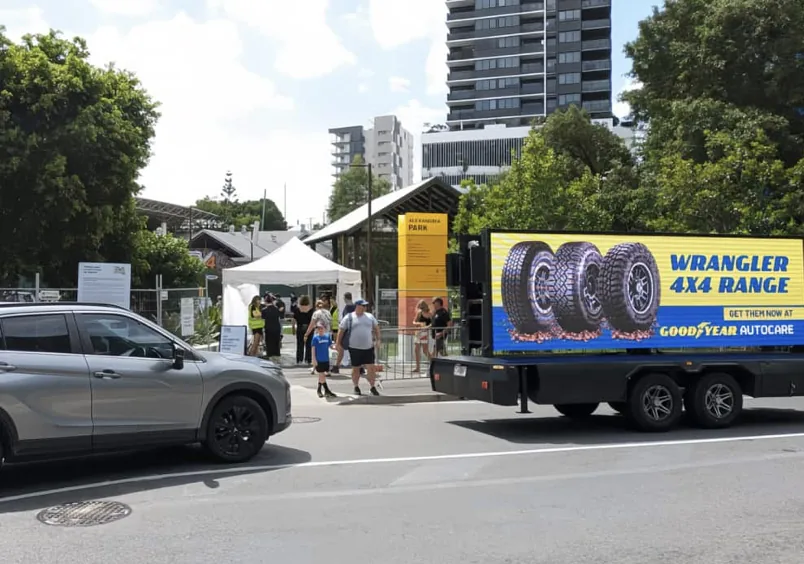
Start with the right asset
Double-sided models for roadside routes, single-face models for event work. Both financeable from $5,000 with the first payment deferrable.
MB-5DFrom $36,500Two 9.84' x 4.92' · Two faces on one mast. Double the impressions from a single tow.
MB-7DBuilt to orderTwo 12.6' x 6.3' · Two 12.6' x 6.3' faces back to back. Large-format double-sided advertising.
MB-5 LiteFrom $30,0009.84' x 4.92' · The entry point. Single-axle starter trailer with real MOBO hydraulics.
MB-10From $55,00013.12' x 8.2' · The workhorse. 100+ sq ft, 18 ft lift, onboard audio.
All 15 MOBO modelsFull lineupEvery trailer, golf cart, and solar unit with specs, downloads, and pricing.
Frequently asked
If your question is not here, call or use the quote form and we will answer it straight.
The trailer is the main capital item. A single-sided MB-5 Lite starts at $30,000 and the double-sided MB-5D, which is the model most advertising operators start with, starts at $36,500. The MB-10 at $55,000 is the common step up. On top of that budget a tow vehicle rated for the weight, commercial auto and equipment insurance, business formation, covered storage, fuel, and content production. Financing through Providence Capital Funding starts at $5,000 with the first payment deferrable 60 to 90 days; approval is not guaranteed.
You need what any commercial trailer operation needs: a business entity, commercial insurance, a correctly registered and DOT-compliant trailer, and a driver licensed for the combination you are towing. What catches operators out is not licensing but local sign ordinances. A number of US cities and counties specifically regulate or restrict mobile billboard advertising, including where you may park an advertising vehicle and for how long. Check the sign ordinance in every jurisdiction on your route before you promise a client placement there.
Yes. Every MOBO trailer is US DOT compliant with a VIN that decodes in the NHTSA system, DOT-approved lighting, tires and couplers, electric brakes and a breakaway kit, so it registers like any commercial trailer. That is the baseline for this business and it is why buyers should be careful with imported units that cannot be registered.
The common structures are a day rate for a parked or routed placement, a campaign rate over a week or a month, a share-of-loop rate where several advertisers rotate on one screen, and event-specific pricing for festivals and game days. Most operators end up running a mix. What you can charge is entirely a function of your market, your traffic positions and your competition, so build your rate card from local research rather than from a number you read online.
For roadside advertising, usually yes. A double-sided trailer serves traffic in both directions from one parking position, one tow and one setup, which is why the MB-5D delivers the lowest cost per square foot of screen in the line at $36,500 for 97 square feet across two faces. For event work where you have one crowd in one place, a single large face is better than two smaller ones.
One person, no tools, about 10 minutes on the MB-5 family and about 15 on the MB-10 and MB-15. The hydraulic system lifts, unfolds and rotates the screen a full 360 degrees from a wireless remote or wired panel, and outrigger legs stabilize the trailer for winds up to 45 mph deployed. For an advertising route, that means a single operator can reposition several times in a day.
Starting up
Tell us the market you are working and the routes you have in mind. We will spec the trailer, quote it with freight, and walk the financing application with you. The rest of the business is yours, but you will not be guessing about the equipment.
info@fullblastsound.com · San Antonio, TX
Important notice
The information on this page is provided for general educational and informational purposes only. It is not legal, tax, accounting, financial, insurance or other professional advice, and it is not an offer of credit or a solicitation. Fullblast Sound & Lights is an equipment dealer; we are not attorneys, accountants, tax advisors or lenders, and nothing here creates a professional or advisory relationship.
Laws, tax figures, regulations, local ordinances, licensing requirements, lender terms and third-party prices change and vary by jurisdiction and by individual circumstances. You should independently verify anything on this page and consult your own attorney, accountant, tax advisor, insurance agent and lender before acting on it. Figures attributed to our financing partner are theirs, and approval is never guaranteed. Prices and specifications are subject to change and are not an offer.
Nothing on this page is a projection, forecast, guarantee or representation of revenue, income, profit, savings or return. Results from operating equipment depend on factors outside our knowledge or control and vary widely. Fullblast Sound & Lights accepts no liability for decisions made in reliance on this page.